
The Kent Meningitis Scare
Problem, reaction, solution - it's playbook time again.

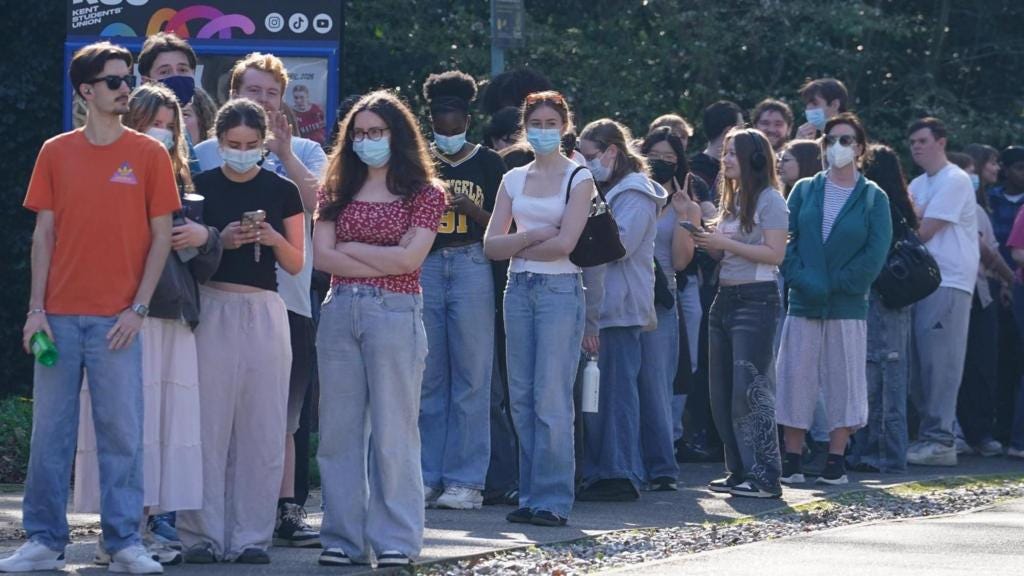
Earlier this month, headlines warned of a meningitis outbreak sweeping through Kent’s university population. Students were urged to get vaccinated. (Some) Parents panicked. Public health machinery mobilised at (warp)speed.
It mobilised, one might note, with remarkable readiness. The previous year, UK schools had participated in Exercise PEGASUS — the largest pandemic simulation in British history — drilling the exact infrastructure of outbreak response that was now being activated for real. The rehearsal preceded the performance. Sound familar?
But beneath the scaremongering, some were once again quietly asking questions grounded not in reassurance or denial, but in mathematics.
Was the outbreak real, or was the surveillance system diagnosing itself?
My friend, Professor Martin Neil, is a Bayesian mathematician. He examined the diagnostic foundations of the Kent cluster and found them structurally unreliable. His analysis centres on a straightforward statistical problem: when you apply broad symptom-based case definitions and single-gene PCR testing to a university population, you are testing a group where the base rate of true invasive meningitis is extremely low, but where three confounding factors converge.
the symptoms used to flag suspected cases — headache, fever, stiff neck, fatigue, nausea — overlap heavily with hangovers, common colds, and routine viral illness. In a student population, these symptoms are near-ubiquitous during term time.
background carriage of meningococcal bacteria in young adults is high. Carrying the bacterium is not the same as being ill with meningococcal disease. PCR tests detect the organism’s DNA. They do not distinguish between harmless nasal carriage and genuine invasion of the bloodstream or meninges.
no diagnostic test is perfect. Even with high specificity, when the true prevalence of invasive disease is very low, the mathematics of conditional probability - Bayes’ theorem - dictate that a significant proportion of positive results will be false positives.
Martin’s calculations, using assumptions he describes as “generous” to UKHSA, show that the posterior probability of true invasive meningitis remains extremely low even after a patient presents with compatible symptoms and returns a positive PCR. The early inflated case counts, he argues, are not a failure of execution but a predictable consequence of the surveillance design itself. The later “downgrading” of cases is not reassuring correction — it is the system catching up with its own false-positive rate.
The pattern is familiar by now (assuming you did not sleep through the early part of this decade): cast a wide net in a population full of noise, count everything the net catches, and the outbreak announces itself.
Into this environment of elevated case counts and media coverage, mass vaccination campaigns were inevitably deployed (money), particularly targeting the B strain of meningococcal disease with newer vaccine formulations (even more money).
The MenB vaccine was only added to the infant schedule in 2015, which means the entire university-age cohort had never received it. An unvaccinated population, a declared outbreak, and a government ready to act: the conditions for a rapid mass rollout were structurally complete. How convenient?
At this point, we hand the baton over to my other friend, Jessica Rose. She’s a molecular biologist. She examined the risk profile of these vaccines and was concerned. Documenting reports from previous meningitis vaccine campaigns, Jessica identifies significant numbers of cases of meningitis occurring shortly after vaccination. The temporal clustering of these cases, she argues, suggests more than coincidence.
The newer B-strain vaccines are engineered to produce a strong immune response. By design, they aggressively stimulate the immune system. Jessica’s analysis suggests this mechanism can backfire. In some individuals, the inflammatory response triggered by the vaccine itself may cause the very condition it is meant to prevent, or produce other serious immunological complications. Sound familiar?
Her assessment is direct: these vaccines may cause more problems than they solve, particularly when deployed at population scale into a situation where the underlying threat may have been overstated from the start (cue Martin).
There is something beautiful in what Martin and Jessica each demonstrate, from their different vantage points. A Bayesian prior does not care who issued the press release. A conditional probability is unmoved by the authority of the institution that designed the test. The inflammatory cascade triggered by an adjuvant does not consult the policy objectives behind the vaccination campaign. Mathematics and molecular biology simply describe what is. They are indifferent to whether you believe them, whether a committee endorsed them, or whether the conclusion is convenient.
This is their power, and it is precisely why these disciplines are so rarely consulted by the public in moments of alarm. An authoritative narrative — delivered by familiar institutions, amplified by media, and shared by everyone around you — is easy and convenient to accept. It requires no calculation, no weighing of priors, no understanding of specificity versus sensitivity. It asks only that you trust “authority” and comply.
The mathematics of false-positive rates in low-prevalence populations is not easy. It requires you to sit with uncertainty, to hold two numbers in your head and understand why their ratio matters more than either one alone. Most people, understandably, will choose the narrative that has already been digested for them over the one that demands they have to work hard at - and let’s be honest, the work that should have been done many years ago in preparation.
But the narrative can be wrong, and it most often is, such that it is polluted by political and economic interests. The mathematics cannot. It does not matter how many people repeat a false-positive count - Bayes’ theorem will quietly, patiently, say the same thing it always said. The truth of a conditional probability is not subject to consensus, and it does not erode under repetition of the counter-narrative.
What emerges from these two analyses, taken together, is not a story about a single misdiagnosis or a single bad vaccine lot. It is a structural pattern and it succeeds precisely because the disciplines that would expose it are harder than the narrative that conceals it.
Broad diagnostic criteria generate high case counts. High case counts generate media coverage. Media coverage generates public fear. Public fear generates demand for intervention. Intervention is deployed rapidly, with its own risk profile unexamined against the backdrop of inflated numbers.
PROBLEM - REACTION - SOLUTION
At no point in this sequence does anyone need to act in bad faith. The surveillance system does what it was designed to do. The media reports what the surveillance system produces. The public responds rationally to what the media reports. And the health response follows the public demand. Each link in the chain behaves logically. The aggregate result is an escalation machine that manufactures its own justification and runs unopposed as long as no one pauses to do the arithmetic - or rather listen to those who do.
None of this machinery was invented for Kent. It was rehearsed, at global scale, during COVID-19 - ironically including Kent at the inception of the second wave in the UK - and anyone paying attention will recognise every component.
A PCR test with cycle thresholds high enough to detect non-viable viral fragments was applied to mass populations, producing case counts that conflated active infection with residual RNA. Broad symptom definitions — cough, fever, fatigue, loss of taste — overlapped with dozens of common conditions. “Cases” replaced “illness” as the unit of public discourse, and the distinction between a positive test and a sick person was abandoned once again. The inflated numbers drove media saturation, which drove public fear, which drove demand for a rapid vaccine rollout — deployed under emergency authorisation, with long-term safety data replaced by urgency.
THE EXACT SAME PLAYBOOK AS COVID-19
The same structural pattern. Broad diagnostic criteria. Imperfect tests applied at scale to low-prevalence or ambiguous populations. Case counts that function as fear metrics rather than clinical indicators. And an intervention deployed into the manufactured demand, carrying its own risks that are unmeasurable against the inflated baseline.
Kent is not an echo of COVID. It is the same mechanism, running the same programme, on a smaller stage. The only difference is that this time, the playbook is visible to anyone who took in the last performance. The diagnostic architecture that manufactured a global pandemic has not been dismantled. It has simply been redeployed. Alas, it does not seem like everyone was paying attention.
Martin and Jessica both arrive at the same practical recommendation, from different starting points:
Do not let fear override individual assessment.
Know the actual warning signs of invasive meningitis — the rash that does not fade under pressure, sudden high fever with altered consciousness, severe and rapidly worsening headache. These are specific. They are distinct from the broad symptom lists used in population surveillance.
Weigh any medical intervention against the actual probability of the threat it claims to address — not against the headlines.
And when the next outbreak is announced, ask the first and most important question:
Who benefits from it?
PCR is a research tool.. not diagnostic "test" That's why it's inventor the vocal anti-Fauci Kary Mullis was "unalived" possibly by said Fauci minions. PCR must be removed as a basis for "disease 'testing" or this crap will never end.. Faith over fear! God Bless
Bacterial meningitis does not occur in clusters. The diagnosis involves a lumbar puncture not PCR. As was the case with Covid, each outbreak is preceded by jab rollout.
There is currently a virus going around which I believe is being spread via Covid jabs, which mimics the symptoms of meningitis. Headache, stiff neck, etc. If anyone experiences these symptoms, wrap up, stay warm, get plenty of rest and stay hydrated. Above all, do not be fearful and do not allow yourself to be coerced into taking a jab.